Furniture planning
Choosing a Sofa for Your Home: Size, Comfort, Fabric and Delivery Access
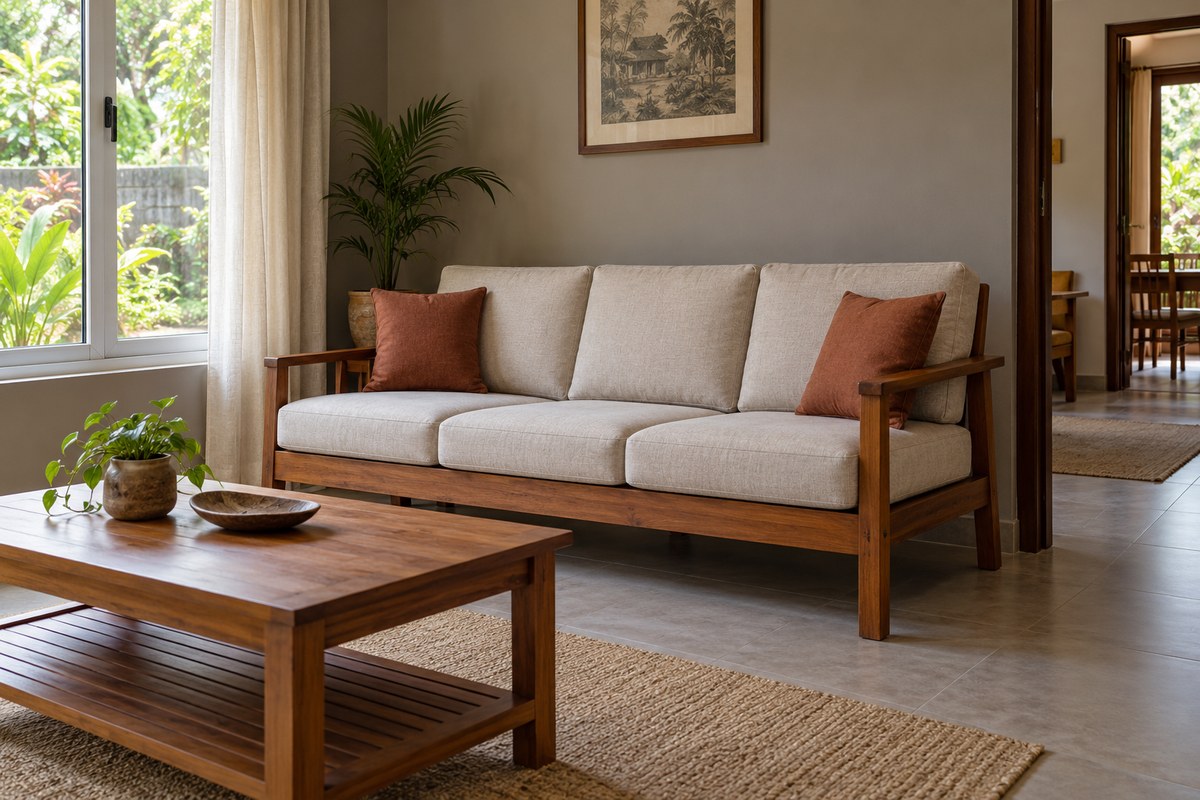
Choose a sofa in this order: confirm that it fits the room and delivery route, test how the people using it actually sit, then agree the frame, cushions, upholstery and care requirements in writing. Colour comes after those decisions. A large sofa can offer surprisingly little sitting space when its arms are wide; a compact model can still feel too deep for its owner. This guide helps you compare complete specifications rather than attractive photographs, whether you are buying ready-made seating or commissioning furniture for a Sri Lankan home.
Compare sofa choices by the trade-off
| Choice | Useful when | Check before ordering |
|---|---|---|
| Straight sofa and separate chairs | The seating arrangement may change | Combined footprint and clear routes |
| Corner sofa or chaise | Lounging is a regular priority | Corner orientation, delivery sections and access |
| Fixed upholstery | A tailored appearance is preferred | Approved cleaning method and reupholstery access |
| Removable casings | Cover replacement matters | Removal method, washing permission and spare supply |
Start with the people and everyday use
Write a short seating brief before visiting suppliers. Who sits here most often? Do you receive guests, watch television, read, or stretch out? Count the seats needed on an ordinary evening separately from occasional gatherings. An extra movable chair may serve visitors better than a permanently oversized sectional.
Include children, pets, anyone who finds low seating difficult, and the person who does the cleaning. Ask each regular user what is uncomfortable about the existing sofa. Keep furniture you already own in the plan. A new sofa should work with the armchairs, television position and room entrances, rather than forcing every other item to move.
Measure the whole footprint and usable seat
Record the sofa's overall width, depth and height, then ask for the clear seat width between the arms, seat depth and seat height. These describe different things. Two models with the same outside width can provide different usable seating. Include loose back cushions when assessing effective seat depth.
Mark the proposed footprint on the floor with paper or removable tape suitable for the finish. Add the coffee table and existing chairs, then walk the room normally. Check door swings, curtains, cupboards and access to sockets. Test recliners fully open and sofa beds in sleeping mode, not only closed. Do not treat a rendered image as a measured layout. In a narrow room, a straight sofa with a separate chair may preserve flexibility better than an L-shaped model; the correct answer depends on your measured plan.
Check the delivery route before paying a deposit
Measure the clear openings along the entire route: gate, entrance, internal doors, corridors, staircase turns and lift where relevant. Note protruding handles, low ceilings and restricted turning areas. Room fit and delivery fit are separate checks. A doorway width alone cannot confirm that a long rigid item can turn through a corridor.
Give photographs and measurements to the supplier and ask them to confirm access using the largest delivered section and its packaging. Ask whether legs or arms are designed to detach, who reassembles them, and whether that affects the warranty. Do not assume a sofa can be dismantled because a similar model could. Agree responsibility and extra charges for difficult access in advance; do not plan improvised lifting through windows.
Test comfort with the actual users
Sit back in your usual position, with your normal footwear or barefoot as at home. Can your feet rest comfortably? Does the back support you without a pile of extra cushions? Try standing up, leaning on an arm and sitting beside another person. A deep lounge seat and an upright conversation seat solve different needs. There is no single ideal dimension for every body.
Test the cushion construction offered in the quotation, not just the showroom's softest display model. Ask what provides support beneath it and whether seat or back fillings can be replaced. Words such as premium, high density or orthopedic do not explain the complete construction or guarantee personal comfort. For specific mobility or medical needs, seek appropriate professional advice and test the actual furniture.
Specify the frame, support and repair options
For a natural timber direction, ask which structural parts are solid teak or mahogany and which parts use other materials. An exposed timber leg does not establish what is inside an upholstered frame. Request a component description, joint details appropriate to the maker's design, the timber finish and care instructions. This is a purchasing brief, not a substitute for the maker's production drawings.
Ask about loose joints, movement, upholstery access, replacement cushion availability and warranty exclusions. A repairable design may be more useful than elaborate concealed details. For a custom order, approve the overall dimensions, usable seat, arm profile and sample finish before fabrication. Record tolerances with the maker rather than inventing a universal furniture standard.
Choose upholstery you can realistically maintain
Take a fabric sample home and view it beside the floor, curtains and existing furniture in daylight and evening light. Compare texture, snagging risk and how visible everyday marks will be. A pale fabric is not automatically impractical, and a dark fabric is not automatically easy to clean. Ask for the fabric's exact identity and written care instructions instead of relying on colour or a performance label.
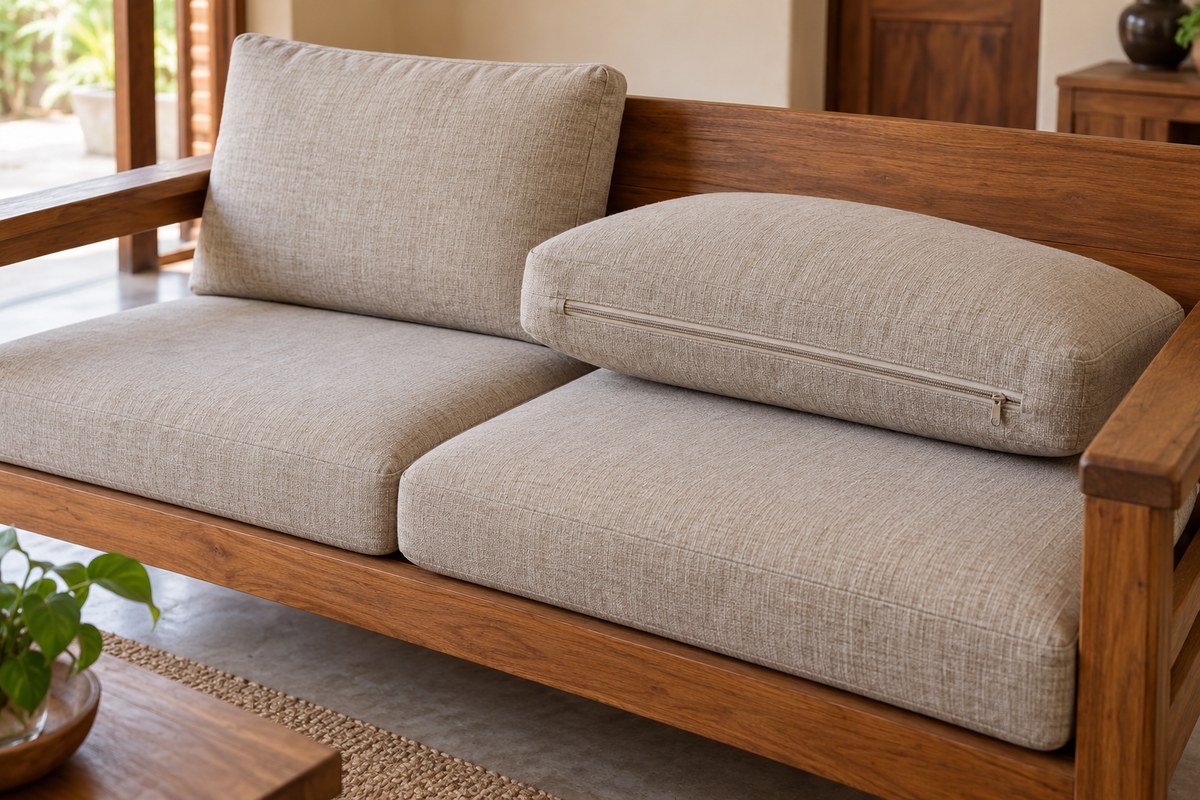
Removable does not automatically mean machine washable. Confirm which casings can be removed, whether the lining must remain, the permitted cleaning method and how replacement covers are ordered. Sunbrella's guidance is useful as an example of product-specific care: it also says to check with the furniture maker before removing some casings. Its cleaning methods must not be applied to unrelated fabrics.
In humid or rainy weather, think about where washed covers can dry completely and how the sofa stays away from wind-driven rain. Do not refit damp covers over cushions. Follow the actual product's instructions; avoid experimenting with bleach, steam or soaking an unidentified upholstery assembly. If cleaning access is difficult, discuss a suitable professional service before buying.
Compare the complete quotation, not the headline price
Ask each supplier to price the same approved brief. Separate the frame and finish, support system, cushion filling, fabric quantity and identity, tailoring, delivery and assembly. Curved shapes, deep tufting, patterned fabric matching, removable covers, mechanisms and difficult access can change the cost. Request taxes and transport charges explicitly; no current local price range is assumed in this guide.
Confirm whether throw cushions, spare covers, disposal of the old sofa, upstairs carrying and later adjustments are included or excluded. Agree payment stages, lead time, warranty process and what happens if the approved fabric is unavailable. Do not allow a substitute simply described as similar. Keep the signed brief, fabric sample reference and quotation together so appearance, cost and aftercare remain linked.
Make the final decision with a simple trial
Shortlist two realistic options and compare them against the same room plan. For example, a household that hosts conversation may prefer a straight sofa with upright armchairs, while someone who lounges alone may value a chaise. Neither choice is universally better. Check who loses access or comfort when one person's preference takes priority.
Common mistakes are ordering from a photograph, calling a model a three-seater without checking usable width, measuring the room but ignoring the delivery turn, and choosing fabric before reading the care instructions. Before paying, resolve every blank in the brief. BJ Atelier can help coordinate furniture planning and cost comparisons from photos, measurements and a clear household brief; online consultations are available from our Chilaw base.
Your next-step checklist
- Write the normal seating needs and retain existing furniture in the plan.
- Record outside dimensions and usable seat measurements separately.
- Check the complete delivery route with the supplier.
- Test comfort using the proposed cushion specification.
- Approve frame materials, fabric identity, finish and written care instructions.
- Confirm inclusions, exclusions, access charges, lead time and warranty before paying.
Common questions
Is a bigger sofa always better value?
No. Compare usable seating, comfort and room access. Wide arms or an unused chaise may occupy space without serving your everyday needs.
Should I choose a firm or soft seat?
Try the actual construction. Your posture, body and intended use matter more than a label. Make sure the ordered cushions match the tested specification.
Does a zipper mean a cover is washable?
No. It may be intended only for assembly or professional servicing. Ask for the exact casing and filling care instructions before removing it.
Can a custom sofa solve difficult access?
Sometimes, if the maker designs suitable delivered sections and connections. Confirm this before production; custom-made does not automatically mean dismantlable.
Can I choose the sofa entirely from an AI image?
Use the image for style direction. Measurements, comfort, materials, delivery and maintenance need separate confirmation through a real brief, samples and supplier checks.
Related planning guides
Further reading & sources
Make the idea work for your home.
Share your location, room photos, dimensions and budget range. We can help you choose the appropriate design, drawing or costing service.
Explore design services →Prepared with AI assistance for BJ Atelier. These articles offer general planning guidance. Project-specific dimensions, specifications, professional checks and prices are agreed separately.