Window treatments
Curtains for Sri Lankan Homes: Balance Daylight, Privacy and Heat
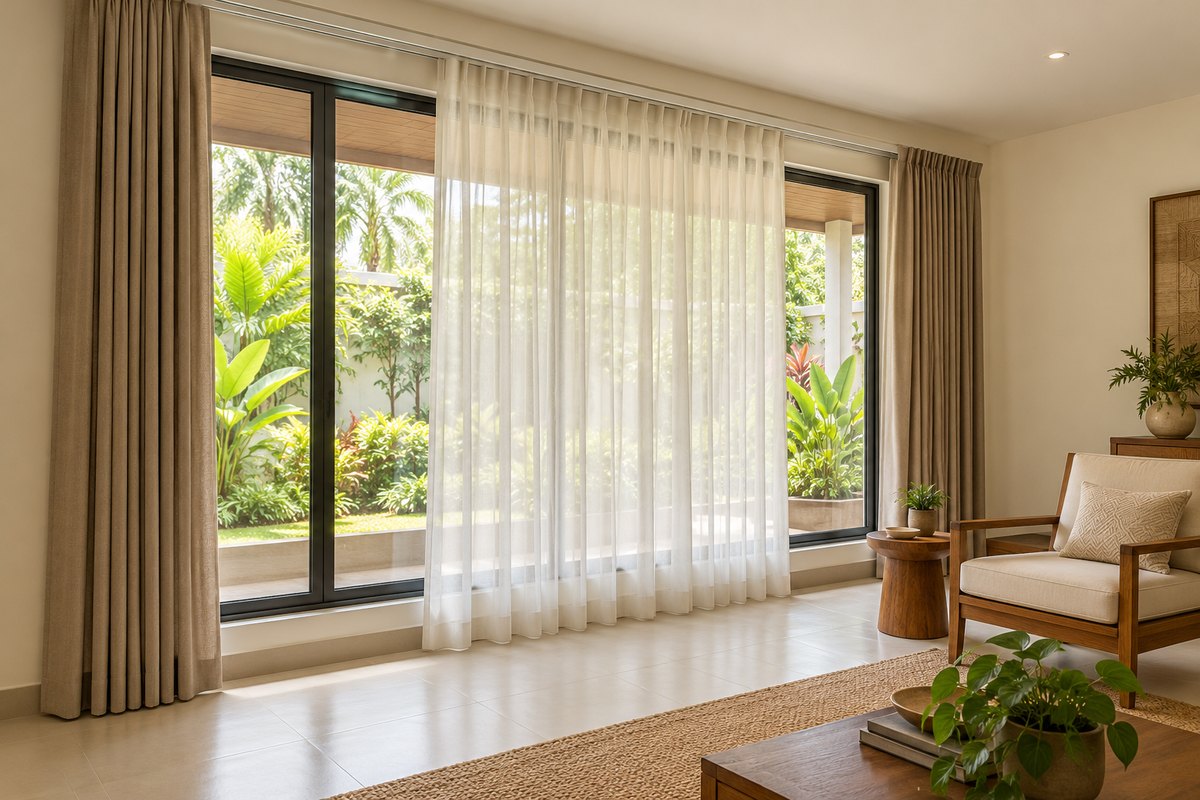
Choose curtains by the job each window must do: soften daylight, provide privacy, darken the room or leave space for ventilation. A sheer and a separate lined curtain can offer flexible control, but a simpler blind may suit a tight corner. Check the actual window and daily routine before choosing fabric. Curtains can manage light and contribute to comfort; they cannot replace appropriate external shading, ventilation or the rest of the building design.
A quick choice guide
| Option | Useful role | Check before ordering |
|---|---|---|
| Sheer curtain | Soft daylight and a filtered view | Night visibility; not guaranteed privacy |
| Lined curtain | More coverage and adjustable light control | Actual fabric, lining, edge gaps and cleaning |
| Sheer plus separate curtain | Independent daytime and evening settings | Double-track space and stacking room |
| Roller or Roman blind | A compact treatment where fabric stacks are awkward | Window handles, cleaning access and cord safety |
Start with a window-by-window brief
Visit the room in the morning, afternoon and after dark. Note when direct sun reaches the glass, where glare lands and what a person outside can see. Record whether the room is naturally ventilated, air-conditioned or used both ways. A street-facing bedroom and a shaded garden window need different answers, even in the same house.
Write one priority beside each opening: daytime light, night privacy, daytime sleep or an unobstructed view. Add secondary needs such as easy washing or avoiding fabric near a work surface. This brief prevents buying the same heavy curtain everywhere simply because the fabric is available as a matching set.
Choose the fabric by function, not only its name
A sheer can soften daylight and reduce the feeling of exposure while retaining some view. It is not a reliable promise of privacy, particularly when the room is brighter than outside. A lined curtain adds coverage and body; the exact lining, weave and colour determine how much light passes through. Dim-out and blackout labels should be checked against the supplier's actual sample and product information.
Look at the sample in front of your own window, not only under shop lighting. Fold it to see the finished weight and inspect the reverse face. Ask whether the lining is separate or bonded, how it should be cleaned and whether replacement fabric can be obtained later. A familiar fibre name alone does not establish performance.
Test privacy again after dark
Make the evening test part of approval. Switch on the lights normally used in the room, close the proposed covering and ask a trusted household member to check the view from the relevant public approach. Check side gaps, the meeting point of curtain panels and the reflected view through nearby glass. You do not need to share private photographs to carry out this test.
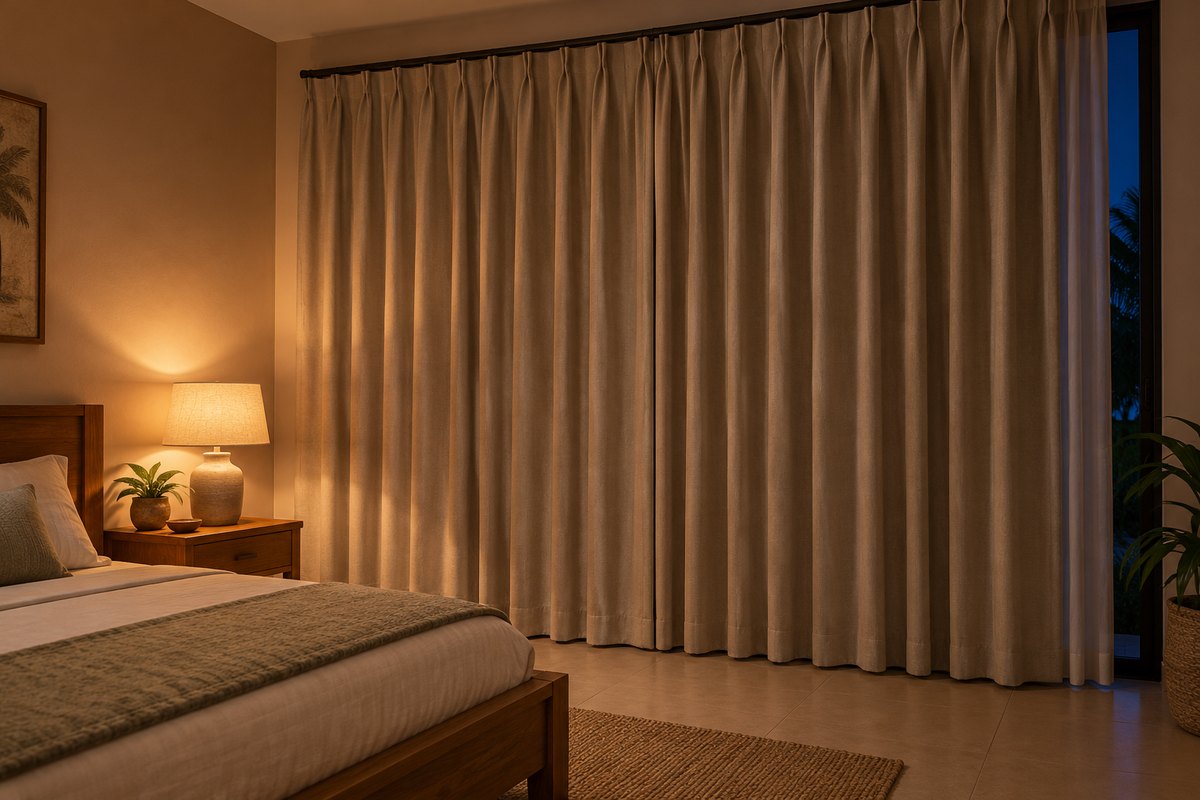
For a bedroom, decide whether silhouettes are acceptable or whether the covering needs to obscure the interior fully. A separate opaque layer gives more control than expecting one decorative sheer to do every job. Avoid assuming a film or a dark fabric will provide the same result under every lighting condition.
Treat heat control as a separate design decision
Curtains inside the room act after sunlight has passed through the glass. PNNL's window-attachment guidance explains why comparable external shading can be more effective at limiting solar heat gain. Your Home also emphasises matching shade to climate and orientation. These are design principles, not a promise of a particular temperature reduction in a Sri Lankan room.
If strong afternoon sun reaches the window, discuss external shade as well as fabric: an appropriate overhang, screen or other site-specific solution may be relevant. Ask a designer to check local sun paths, wind, access and rain rather than copying Australian orientation rules directly. Also investigate roof heat and other room conditions before blaming the curtain alone.
Leave room for window operation and air movement
Open every window leaf and door before agreeing the track position. Check projecting handles, inward-opening shutters, insect screens and nearby wardrobe doors. Fabric should park where it does not repeatedly catch on a handle or obstruct the opening. A double track needs more space than a single curtain, so show both layers on the measurement record.
For a naturally ventilated room, plan how to secure the curtain to the side without blocking the useful opening. Do not rely on loose fabric blowing across a window as ventilation planning. Keep coverings clear of cooking equipment and any heater, and follow the appliance manufacturer's clearance instructions. Window access and safe escape routes must remain usable.
Measure the finished installation, not just the glass
Record the opening width and height, wall space on both sides, ceiling position, skirting, sill projection and the nearest furniture. Photograph the area with a tape measure visible for reference, then let the supplier verify final sizes. Agree where the curtain will start and finish and where the fabric will stack when open.
Ask the maker to specify the finished curtain drop, track length, heading style, fullness, number of panels and lining on the quotation. There is no universal extra width or mounting height that works for every room. Ceiling-mounted curtains can create a continuous visual line, but only if the support, access and proportions suit the actual room.
Choose a maintenance routine your household can follow
Ask for written washing or cleaning instructions before paying a deposit. Confirm whether the face fabric and lining can be cleaned together, whether shrinkage is expected and how the supplier has allowed for it. Check whether hooks and panels can be removed without dismantling a complicated installation. Choose a manageable panel size if regular washing is important.
In humid rooms, inspect for dampness and allow wet areas to dry; do not trap fabric against a persistently wet wall or sill. A curtain does not repair a leak. Keep hems away from regularly wet floors and consider a more suitable covering near splash zones. Repair the source of moisture before replacing stained fabric.
Include child safety and fixing conditions
CPSC identifies accessible window-covering cords as a strangulation hazard and recommends cordless options where young children are present. Ask the supplier how every part of the chosen product operates; do not assume a decorative tie or a high mounting position removes a cord hazard. Keep beds and climbable furniture away from the window-covering controls.
The installer must also identify the supporting wall or ceiling and select appropriate fixings for the complete curtain weight. A suspended ceiling should not be assumed to support a heavy track. Have the fixing position checked for concealed services and safe access. Motorised systems need the appropriate qualified electrical input; this guide is not a wiring or structural fixing instruction.
Compare complete quotations and common mistakes
Compare the same finished installation: face fabric, lining, sewing, heading, track, brackets, end stops, fitting, transport and removal of old hardware where required. Clarify who measures, who repairs disturbed paint and what happens if the finished drop is wrong. A fabric-only metre rate cannot be compared fairly with an installed curtain price.
Costs depend on fabric width, pattern matching, fullness, lining, track length, number of openings, access and automation. Ask for those quantities and inclusions rather than an invented universal room price. Common mistakes include testing privacy only in daylight, forgetting stacking space, covering a handle and choosing a long hem where the floor is frequently wet. Resolve these on a marked-up photograph before ordering.
Apply the brief to two ordinary rooms
For a shaded living room facing a garden, start by testing a light-filtering layer. Add a separate evening-privacy layer if the household needs it. Keep the stack clear of a frequently used door, coordinate one fabric sample with the sofa and wall colour, and check that the curtain does not cover the useful breeze opening. The aim is flexible daily use, not the greatest number of fabric layers.
For a bedroom receiving strong afternoon sun, separate three questions: outside shading, night privacy and sleep darkness. Test a lined curtain or suitable blind against the real window, including edge gaps. If the room is used for daytime sleep, ask for a mock-up of the proposed light-control arrangement before approving the whole order. These are planning examples, not reports of completed client work.
Your next-step checklist
- Record sun, privacy and cleaning needs for each window.
- Test the exact sample in daylight and after dark.
- Check open windows, handles, furniture and fabric stacking space.
- Approve finished dimensions, lining and track specification in writing.
- Choose child-safe operation and have supports checked.
- Compare the complete installed scope and keep care instructions.
Common questions
Are sheer curtains private at night?
Not reliably. Visibility depends on the fabric and lighting on both sides. Test the actual sample with normal indoor lights on and add a separate privacy layer where needed.
Does blackout fabric guarantee a completely dark room?
No. Light can enter around the sides, top and bottom or through other openings. Agree a complete installation detail and test the proposed arrangement.
Can curtains replace exterior shading?
They serve different roles. Interior curtains help control light and privacy; external shading stops sunlight before it reaches the glass. Assess both against the actual climate and window exposure.
Is ceiling mounting always better?
No. It can suit some proportions, but fixing support, cleaning access, window operation and furniture still decide whether it is appropriate. Confirm the actual track and curtain dimensions.
What should I send for a curtain design enquiry?
Send room and window photos, opening dimensions with units, town, intended use, privacy needs and budget direction. BJ Atelier offers design guidance and online consultations; supply, measurement and installation scope must be agreed separately.
Related planning guides
Further reading & sources
Make the idea work for your home.
Share your location, room photos, dimensions and budget range. We can help you choose the appropriate design, drawing or costing service.
Explore design services →Prepared with AI assistance for BJ Atelier. These articles offer general planning guidance. Project-specific dimensions, specifications, professional checks and prices are agreed separately.